Test-Driven Development (TDD): The Power of TestNG

Introduction
Test-Driven Development (TDD) combined with the power of TestNG creates a robust framework for agile software development. TestNG (Next Generation) is a powerful, open-source testing framework for Java, designed to support a wide range of testing needs, from unit to integration testing. It complements TDD perfectly by enabling developers to write efficient, organized, and scalable tests.
Key Features of TestNG in TDD
· Annotation-Based Framework: TestNG leverages annotations like @Test, @BeforeMethod, and @AfterMethod, simplifying test creation and management.
· Flexible Test Configuration: Developers can define dependencies between tests, specify groups, and customize test execution.
· Parameterization: TestNG allows parameterized tests, enabling developers to test multiple scenarios with minimal effort.
· Built-In Reporting: It generates detailed test reports, making it easier to track progress and identify issues.
· Integration with Tools: TestNG integrates seamlessly with popular build tools like Maven and Gradle, and continuous integration platforms like Jenkins.
Challenges to Consider
· Learning Curve: TestNG's advanced features may require time to master.
· Dependency Management: Properly configuring test dependencies is essential for smooth execution.
· Maintenance: As with any TDD approach, maintaining test cases alongside evolving code is crucial.
Test-Driven Development (TDD)
TDD follows a disciplined approach to software development that revolves around writing tests before implementing the actual code. Here are its main principles:
Write tests first – Before writing any implementation code, define test cases to specify the expected behavior.
Red-Green-Refactor cycle – Write a failing test (red phase), implement the code to pass the test (green phase), then optimize the code (refactor phase).
Incremental development – Build software in small, testable increments to maintain control over complexity.
Continuous feedback – Tests provide immediate validation, ensuring correctness throughout development.
Refactoring without fear – Since tests validate behavior, developers can confidently refactor code without introducing bugs.
Benefits of TDD
1. Early Bug Detection
Since tests are written before the implementation, developers catch errors early in the development cycle, reducing debugging time.
2. Better Code Design
TDD encourages modular, loosely coupled, and testable code, leading to cleaner architecture.
3. Faster Development
While writing tests may seem time-consuming at first, TDD actually speeds up development by reducing time spent on debugging and fixing issues later.
4. Confidence in Code Changes
Developers can refactor code or make changes without fear, knowing that tests validate expected functionality.
5. Improved Documentation
Well-written tests act as live documentation, explaining how different parts of the system are expected to behave.
6. Reduces Dependencies on Debugging
Developers rely less on extensive debugging since tests continuously validate the correctness of the code.
7. Facilitates Continuous Integration (CI/CD)
Automated tests make it easier to integrate new features without breaking existing functionality, ensuring smooth deployments.
Importance of TestNG
TestNG is a powerful testing framework for Java that enhances the capabilities of JUnit and provides additional features for efficient test execution. Here’s why TestNG is important: Key Benefits of TestNG
Advanced Annotations – TestNG offers flexible annotations like @BeforeSuite, @AfterSuite, @DataProvider, and more, making test management easier.
Parallel Execution – Unlike JUnit, TestNG allows running tests in parallel, reducing execution time.
Dependency Management – You can define test dependencies using dependsOnMethods, ensuring tests run in a logical order.
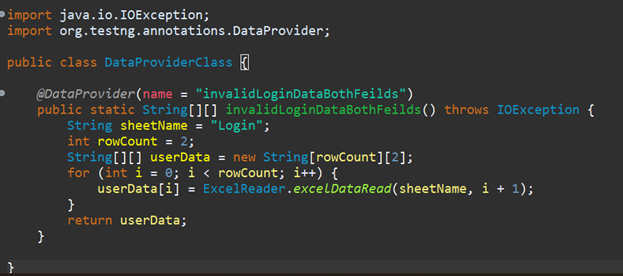
Data-Driven Testing – The @DataProvider annotation enables parameterized testing, allowing multiple test scenarios with different inputs.
Example
Better Reporting – TestNG generates detailed HTML reports, making it easier to analyze test results.
Integration with Selenium – TestNG is widely used in Selenium automation testing, improving test structure and execution.
Red-Green-Refactor Cycle:
Red Phase (Write a Failing Test) Write a unit test before implementing the functionality.
Run the test—since the feature doesn't exist yet, it fails.
Green Phase (Write Minimal Code to Pass the Test) Implement just enough code to make the failing test pass.
Refactor Phase (Improve Code Quality) Refactor the code for efficiency, readability, and maintainability.
Ensure all tests still pass after refactoring.
How TDD and TestNG Work Together
Test-Driven Development (TDD) and TestNG are closely related because TestNG provides an advanced testing framework that supports TDD principles in Java development.
TestNG as a Testing Tool for TDD – In TDD, developers write tests before implementing code. TestNG offers powerful features like annotations, parallel execution, and data-driven testing to streamline this process.
Red-Green-Refactor Cycle – TDD follows a cycle where: A TestNG test is written to define expected behavior. The test fails initially since the functionality isn't implemented. Programmers write the minimum code to pass the test.
Finally, they refactor the code while ensuring the test still passes.
Advanced Test Management – TestNG allows grouping tests, setting dependencies, and running tests in parallel, making TDD more efficient.
Data-Driven Testing – The @DataProvider annotation in TestNG enables parameterized testing, which is useful for validating multiple scenarios in TDD.
Integration with CI/CD – TestNG works well with continuous integration tools, ensuring automated testing in TDD workflows.
Overall Functions

Conclusion
Test-Driven Development (TDD) powered by TestNG brings discipline, efficiency, and reliability to software development. By combining the principles of TDD with the robust features of TestNG—such as annotation-based testing, parameterization, and seamless integration with other tools—developers can create well-structured, high-quality code while ensuring thorough test coverage.
TestNG not only streamlines the testing process but also supports iterative development by allowing for continuous testing and refactoring. It enables developers to identify and resolve issues early, improving the overall software quality and reducing long-term maintenance costs. However, to harness its full potential, teams must invest in learning TestNG's features and maintaining tests alongside evolving code.
In essence, TDD with TestNG is a powerful combination for building scalable, reliable, and maintainable applications in agile and fast-paced development environments.