SQL vs Python for Data Analysis: When to Use What?
Many people starting their journey in data analysis eventually face the same question:
Should I use SQL or Python for data analysis?
Both tools are widely used across the industry, and both appear frequently in job descriptions. This often creates confusion, especially for beginners who feel pressured to “pick one.” Over time, however, most analysts realize that SQL and Python are not alternatives — they are complementary tools designed for different parts of the analytical process.
This blog explains when SQL works best, when Python is more suitable, and how they are commonly used together, based on practical, real-world scenarios.
1. Understanding the Role of SQL and Python
Many analysts begin with SQL because it is the most direct way to interact with data stored in databases. SQL allows users to ask clear questions and get structured answers from large datasets.
Python, on the other hand, is often introduced when analysis requires more flexibility — such as custom logic, repeated transformations, or visual exploration.
At a high level:
SQL focuses on querying and summarizing data within databases
Python focuses on manipulating, analyzing, and visualizing data outside the database
Understanding this distinction helps reduce confusion early and sets the foundation for choosing the right tool later.
Once the roles of SQL and Python are clear, it becomes easier to identify situations where one naturally fits better than the other.
2. When SQL Is the Better Choice
SQL is usually the best option when working with structured data stored in relational databases such as Oracle, MySQL, or PostgreSQL.
It is particularly effective when:
Filtering large datasets using conditions
Joining multiple related tables
Performing aggregations like totals, counts, or averages
Reducing data size before analysis
Example:
SELECT department, COUNT(*) AS employee_count
FROM employees
GROUP BY department;
SQL queries are optimized by the database engine, making them efficient even when working with millions of records. For many reporting and summary-level tasks, SQL alone can provide quick and reliable results.
After extracting clean and relevant data using SQL, analysts often move to the next stage of analysis.
3. When Python Becomes More Useful
Python becomes especially valuable when analysis moves beyond simple queries and summaries.
It is commonly used when:
Data requires multiple transformation steps
Business logic becomes complex
Exploratory analysis is needed
Custom calculations or comparisons are involved
Using Pandas, analysts can express logic in a readable and flexible way:
df.groupby('department')['salary'].mean()
Python also allows analysts to test ideas quickly, adjust logic, and experiment with different approaches — something that can be harder to do using only SQL.
As analysis grows in complexity, Python provides the flexibility that SQL alone may not.
4. SQL for Data Retrieval, Python for Analysis
In most real-world projects, SQL and Python are not used in isolation. Instead, they are part of a single workflow.
A common pattern looks like this:
Use SQL to extract filtered and aggregated data from the database
Load the result into Python
Perform deeper analysis, transformations, and visualization
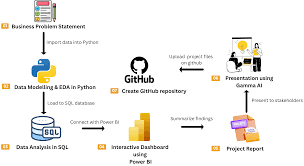
This approach reduces data volume early and allows Python to focus on analysis rather than raw data handling.
Combining SQL and Python in this way leads to cleaner code and more efficient workflows.
5. Comparing SQL and Python Side by Side
Aspect | SQL | Python |
Primary use | Data querying | Data analysis & processing |
Execution | Inside database | External environment |
Strengths | Speed, structure | Flexibility, customization |
Learning curve | Beginner-friendly | Moderate |
Visualization | Limited | Strong support |
This comparison highlights that SQL and Python serve different purposes rather than competing with each other.
Understanding these differences helps analysts choose tools more confidently.
6. Choosing the Right Tool for the Task
Instead of asking “Which tool should I learn first?”, a more practical question is:“What problem am I trying to solve?”
Need summarized data from a database → SQL
Need deeper exploration or visualization → Python
Need end-to-end analysis → SQL + Python
Making tool choices based on the task helps keep solutions simple and maintainable.
7. Common Mistake: Trying to Do Everything with One Tool
A common mistake among beginners is relying too heavily on a single tool.
Examples include:
Writing overly complex SQL queries for tasks better handled in Python
Pulling entire tables into Python without filtering data using SQL
Both approaches can make analysis slower and harder to maintain. Learning to balance tools leads to clearer and more efficient solutions.
Using the right tool at the right stage improves both performance and readability.
Final Thoughts
SQL and Python are both essential skills for data analysts. Rather than choosing one over the other, learning when and how to use each is far more valuable.
Most analysts start with SQL and gradually incorporate Python as their analysis becomes more advanced. Over time, using both together becomes a natural and effective way to work with data.
Key Takeaways
SQL and Python are not competing tools; they are often used together in real-world analysis.
SQL works best for retrieving and summarizing data directly from databases.
Python provides flexibility for deeper analysis, transformations, and visualization.
Choosing the right tool depends on the problem being solved, not on popularity.
Using both tools in a balanced way leads to cleaner and more efficient workflows.
Thank you for reading, and happy learning!