Septic is Not Just a Word — A Data Driven Look at Septic Shock


Remember that time you shrugged off a seemingly harmless scrape on your elbow? Most of the time its nothing and you move on. But I clearly remember the warning that my parents gave, that if I don’t clean and disinfect the wound, it may become Septic.
That word stuck with me but I never fully understood the scientific meaning or rather never fully appreciated the thought behind it. But everything changed when I worked on the Sepsis dataset.
Sepsis is a serious condition in which the body responds improperly to an infection. The infection-fighting processes turn on the body, causing the organs to work poorly. And putting it mildly - Sepsis may progress to septic shock. This drop in blood pressure can damage the lungs, kidneys, liver and other organs. When the damage is severe, it can be fatal.
Stages of Sepsis
SIRS (Systemic Inflammatory Response Syndrome):
It happens when your body goes into a medical “panic mode” in response to a major stressor (like an injury, surgery, or an infection). To meets SIRS criteria the patients have to exhibit any two signs.

Sepsis:
Sepsis occurs when a patient meets the SIRS criteria and has a highly suspected source of infection. Most people develop sepsis in the outside world rather than the hospital.
Severe Sepsis:
This stage occurs when sepsis advances to cause acute end-organ dysfunction or tissue hypoperfusion.

Septic Shock:
Septic shock is the final and most severe stage, occurs when a widespread infection leads to dangerously low blood pressure and abnormalities in cellular metabolism.

Risk factors
Your chances for developing septic shock increase if:
You developed pneumonia outside the hospital
You’re age 65 or older
You have a weakened immune system
You’re taking immunosuppressants
You have certain health conditions, like diabetes, obesity or cancer
You’re admitted to the intensive care unit (ICU)
You’ve had previous hospitalizations
You have a biological family history of sepsis
Complications of this condition
Septic shock can lead to several severe complications, including:
Brain damage
Lung failure
Heart failure
Kidney failure
Tissue death (gangrene)
Death
The biomarkers essential for Septic Shock are Systolic Blood Pressure(SBP), Mean Arterial Pressure (MAP), Lactate, Respiratory Rate. Threshold limits used for biomarkers to establish Septic Shock for each patient in this dataset:
SBP < 90
MAP<60 or SBP>40
Resp >= 22
Lactate > 2
Calculations used to derive the Septic Count population:
Septic Shock calculation=
IF { FIXED [Patient ID] : MAX(
(IF [SBP] < 90 THEN 1 ELSE 0 END) +
(IF [MAP]<60 or [SBP]>40 THEN 1 ELSE 0 END) +
(IF [Resp] >= 22 THEN 1 ELSE 0 END) +
(IF [Lactate] > 2 THEN 1 ELSE 0 END)
)} = 4 THEN "SepticShock" ELSE "NO SepticShock"
END
Septic Shock Patient Count =
COUNTD( IF [Septic Shock calculation]= 'SepticShock' THEN ([Patient ID]) END)
Note: All thresholds used in this analysis are intended for educational and analytical purposes only and should not be used for clinical diagnosis or medical decision-making.
In this dataset the total number of patients classified into Septic Shock Category are 296. That means out of 2932 Sepsis Patients, around 10% of patients progressed to Septic Shock. Sepsis is a severe healthcare burden, as it consumes significant resources in all directions. It was observed that a patient who develops and survives Sepsis has an average of ICU prolonged stay of 8 days and incurred thousands of dollars as additional costs. The question is not just how many progressed, but why and the data points to four key biomarkers that tells us that story.
MAP & Lactate
MAP: It is the average pressure pushing blood through your arteries to your vital organs over a single heartbeat. It is the single best way to determine if there is enough continuous blood flow to keep vital organs like your brain, kidneys, and heart alive and functioning properly
Lactate: Lactate is one of the most critical biomarkers in sepsis management and is a core component. Normally, your cells use oxygen to turn glucose into energy(aerobic metabolism).When oxygen is scarce cells switch to Anaerobic Metabolism. The cell produces a small amount of energy and a byproduct: Lactic Acid. This acid leaks out of the cells and into the bloodstream, where it is measured as Lactate.
When treating critical ICU patients, doctors rely on medical risk maps to spot life-threatening conditions like septic shock before it’s too late. This data visualization tracks two ultimate red flags: MAP and Lactate.
Septic Shock zone MAP/Lactate =
IF [MAP]<65 AND [Lactate]>2 THEN "High Risk Zone"
ELSE "Monitoring Zone"
END

When you plot these metrics against each other, the scatter chart establishes clear danger zones. The vertical threshold points where blood pressure drops too low (Hypotension), while the horizontal threshold points where lactate climbs too high (Hypoperfusion). The bottom-left quadrant represents the ultimate danger zone, where patients suffer from both crashing blood pressure and suffocating tissues. By color-coding the data, medical teams can instantly separate high-risk sepsis patients from those who are stable or suffering from non-septic conditions. While other vital signs like SBP, Respiratory rates are helpful, this visual proves that tracking the relationship between MAP and Lactate is a strong indication of Septic Shock severity.
SBP and Respiratory Rate
SBP: Systolic blood pressure is the top (or first) number in a reading. In simple terms, it measures the maximum pressure inside your arteries when your heart beats and pushes blood out to your body. Doctors often pay very close attention to the systolic number because it is a strong indicator of heart attack or stroke risk.
Respiratory Rate: Respiratory rate is simply your breathing rate—the number of times you inhale and exhale in one minute. It is a vital sign that tracks how well your body brings in oxygen and gets rid of carbon dioxide. During Septic Shock, the breathing speed becomes dangerously fast as the body works desperately to take in more oxygen and remove excess acid building up in the blood.
While MAP and Lactate identify patients already in physiological crisis, SBP and Respiratory Rate serve a different but equally important purpose, catching sepsis early, before it reaches that point.
Septic Shock zone SBP/Respiratory Rate =
IF [SBP]<90 AND [Resp]>=22 THEN "High Risk Zone"
ELSE "Monitoring Zone"
END
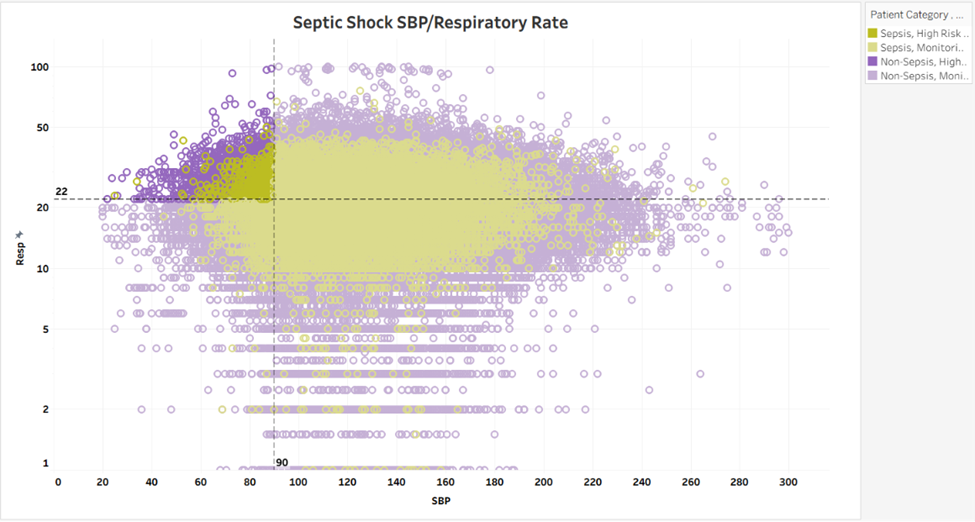
SBP and Resp were plotted in a Scatter plot correlation chart. The top-left quadrant, where a dangerously low blood pressure (below 90) meets an abnormally fast breathing rate (above 22). As shown by the heavy cluster of green dots, when an infected patient crosses both of these thresholds simultaneously, it is clear that their body is failing and need immediate medical intervention.
Behind every data point in this analysis is a patient whose body was fighting to survive. MAP dropping, lactate rising, blood pressure crashing, breathing rate climbing — four biomarkers, one urgent message. Recognizing that message early enough is what separates recovery from tragedy. I finally understood what my parents meant — septic is not just a word; it is a warning.
Thank you for Reading.
References:
