Sepsis to Septic Shock: The Stages You Should Know
Septic Shock
Welcome to my blog and in this blog let us explore more about Septic shock. Before knowing about Septic shock, it is crucial to know about Sepsis. Sepsis is a life-threatening medical condition that occurs when the body’s response to an infection becomes extreme and starts damaging its own tissues and organs. To understand more about sepsis and septic shock, I have taken a sample data set and analyzed it thoroughly to understand the various stages of Sepsis. I have focused more on the patients who are in Septic shock stage. Now, let us elaborately know about Sepsis and its stages.

What is Sepsis?
Sepsis occurs when infection triggers a dysregulated immune response, leading to organ dysfunction. Clinicians often identify this using SOFA score changes or SIRS criteria. Sepsis progresses through several stages, with each stage the severity increases which increases risk to the patient. Early recognition at any stage is critical to improving survival. Septic shock is the last stage of sepsis.
Sepsis Stages
Sepsis is classified into below three stages.
· Sepsis
· Severe Sepsis
· Septic Shock
Sepsis
A Systemic inflammatory response to an infection.
Symptoms:
High/Low temperature
Rapid heart rate (>90 bpm)
Fast breathing (>20 breaths/min)
Severe Sepsis
This stage occurs when sepsis is complicated by organ dysfunction. Often indicated by low blood pressure and organ dysfunction.
Symptoms:
Confusion
Decreased urine output
Difficulty breathing
Septic Shock
Then most critical stage is a severe drop in blood pressure.
Symptoms:
Persistent hypotension
cool/clammy skin
40-50% mortality risk
What is septic shock?
Septic shock is the most severe and life-threatening stage of sepsis, occurring when the body’s overwhelming response to infection leads to dangerously low blood pressure and multiple organ failures. Understanding septic shock and its causes, warning signs, and the urgency of early, aggressive treatment is essential for improving outcomes and saving lives. Sepsis progresses through several stages, with each stage reflecting increasing severity and risk to the patient. Early recognition at any stage is critical to improving survival.
Septic Shock Criteria

Confirmed Sepsis
The patients already met the sepsis criteria. Infection is suspected or confirmed.
Map (Mean Arterial Pressure)
The Map is persistent hypotension requiring vasopressors. After adequate IV fluids, the patients still need vasopressors to maintain them. The criteria for septic shock in Map is,
MAP < 65
Lactate
If the lactate level is,
Lactate > 2 mmol/L
Respiratory
Respiratory criteria often support early recognition,
RR > 22
It’s a sign of respiratory distress.
SBP
SBP (Systolic Blood Pressure) criteria often support early recognition,
SBP < 90 mmHg / SBP > 40 mmHg
Applying This to Data: How We Classify Patients
Once we understand the clinical criteria, we can translate them into logic for analysis. Below is the classification logic you provided, which categorizes patients into Septic Shock, Severe Sepsis, Sepsis, SIRS, or No Inflammation based on vital signs and biomarkers.
This logic helps determine:
How many patients fall into each stage
How severe their condition is
How trends shift over time
It’s a powerful way to turn raw clinical data into meaningful insights.
IF [Sepsis Label] = 1 AND
[SBP] <= 90 AND
[MAP] <= 65 AND
[Lactate] > 4 AND
[Resp] >= 22
THEN "Septic Shock"
ELSEIF [Sepsis Label] = 1 AND (
[Lactate] > 2 OR
[Creatinine] > 2 OR
[Platelets] < 100 OR
[SBP] < 90 OR
[MAP] < 65
)
THEN "Severe Sepsis"
ELSEIF [Sepsis Label] = 1 AND (
(IF [Temp] > 38.5 OR [Temp] < 35 THEN 1 ELSE 0 END) +
(IF [HR] > 90 THEN 1 ELSE 0 END) +
(IF [Resp] > 20 OR [PaCO2] < 32 THEN 1 ELSE 0 END) +
(IF [WBC] > 12 OR [WBC] < 4 THEN 1 ELSE 0 END)
) >= 2
THEN "Sepsis"
ELSEIF (
(IF [Temp] > 38.5 OR [Temp] < 35 THEN 1 ELSE 0 END) +
(IF [HR] > 90 THEN 1 ELSE 0 END) +
(IF [Resp] > 20 OR [PaCO2] < 32 THEN 1 ELSE 0 END) +
(IF [WBC] > 12 OR [WBC] < 4 THEN 1 ELSE 0 END)
) >= 2
THEN "SIRS"
ELSE "No Inflammation"
END
Dataset Explanation:
I have taken a dataset of 40336 patients. After careful and detailed analysis, I have classified this dataset into our major sepsis categories which are Sepsis, SIRS, Severe Sepsis and Septic shock.

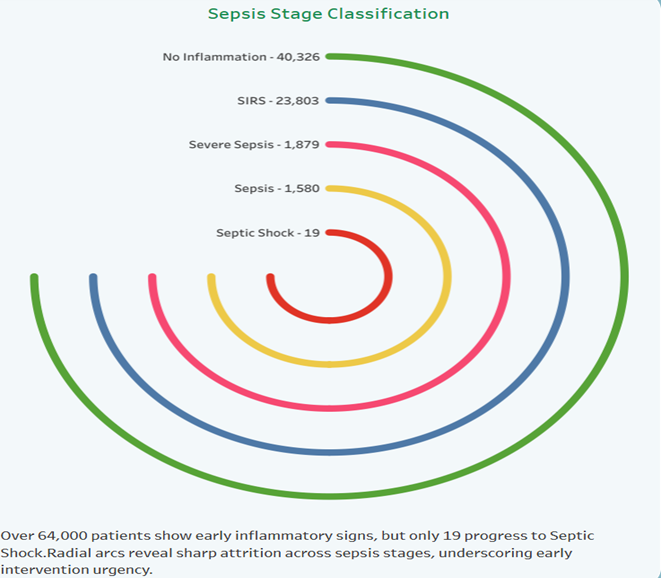
This radial chart visualizes the distribution of patients across sepsis severity stages.
The outermost arc represents patients with No Inflammation, totaling over 40,000 cases, shown in green. These patients form the baseline population.
Moving inward, we see SIRS cases in blue indicating systemic inflammation without confirmed infection.
The next rings represent escalating severity: Sepsis, Severe Sepsis, and finally Septic Shock, with only 19 patients reaching the most critical stage, shown in red.
This structure emphasizes the steep drop-off in case volume as severity increases, reinforcing the importance of early detection and intervention at the SIRS and Sepsis stages.
Conclusion:
Septic shock can often be prevented by treating infections early and recognizing the warning signs of sepsis. Seeking immediate medical care, maintaining good hygiene, managing chronic illnesses, and staying up to date with vaccinations are key steps to stop sepsis from progressing to septic shock and reduce the risk of life-threatening complications.
“Prevention is the first step to protection—stay aware, stay healthy.”