Preferential Ranking: Turning Data into Actionable Priority

When you work with a large number of customers, one common challenge quickly emerges:
Who should be handled first?
In real business scenarios, you’re rarely prioritizing based on just one factor. A customer might be very active but not loyal. Another might be loyal but inactive. Someone else might have a high balance but very low engagement.
You might want to prioritize customers who are:
More active
Recently engaged
Long-term and loyal
High priority or high urgency
The problem is simple but important:If you sort by only one column, you miss the full picture.
That’s exactly where Preferential Ranking becomes powerful.
What Is Preferential Ranking?
Preferential Ranking is a method of ranking records using multiple rules applied in a strict order until all ties are resolved.
Think of it as a decision ladder:
Start with the most important rule
If there’s a tie, move to the next rule
Continue step by step until one record clearly wins
Instead of forcing everything into a single score, preferential ranking respects business priorities in the order they matter.
Why Preferential Ranking Matters
Preferential ranking helps you:
Make fair and defensible decisions
Apply consistent and repeatable logic
Clearly explain why someone ranks higher
Prioritize customers based on real business value
Avoid bias, gut feeling, and guesswork
Rather than asking “Who has the highest value?”, you’re answering:
“Who deserves attention first — and why?”
That shift makes all the difference.
Reference Dataset (Designed for Learning)
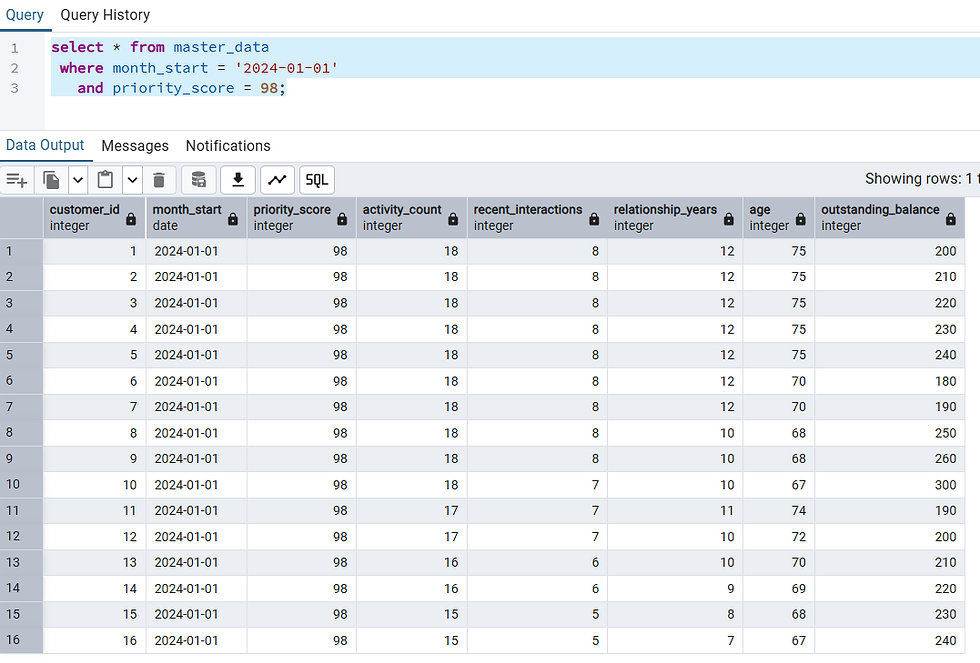
To make the concept easy to understand, I created a reference dataset for January and February, intentionally designing many customers to share the same values.
This forces the ranking logic to work exactly as intended.
In January, there are 16 customers who all share the maximum priority score of 98.
At this point, a simple sort fails — everyone looks identical.
So we introduce ordered business rules.
The Preferential Ranking Rules
Customers are ranked within each month using the following order:
priority_score → higher is better
activity_count → higher is better
recent_interactions → higher is better
relationship_years → higher is better
age → higher is better
outstanding_balance → lower is better
In plain language:
If two customers tie on rule 1, move to rule 2.If they still tie, move to rule 3.Continue until one customer wins.
This ordered logic is the heart of preferential ranking.
Step-by-Step: How the Ranking Actually Works
Step 1: Priority Score
All 16 customers have:
priority_score = 98
No one is eliminated here.
Step 2: Activity Count
Customers now split naturally:
Activity = 18 → Customers 1–10
Activity = 17 → Customers 11–12
Activity = 16 → Customers 13–14
Activity = 15 → Customers 15–16
Since higher activity wins:
Customers 1–10 rank above 11–16
Customers 11–12 rank above 13–16, and so on
Step 3: Recent Interactions (Among Activity = 18)
Within Customers 1–10:
Recent = 8 → Customers 1–9
Recent = 7 → Customer 10
Customer 10 loses here and drops below Customers 1–9 — regardless of balance, age, or loyalty.
This highlights a key principle:
Once a customer loses on a higher-priority rule, lower rules no longer matter.
Step 4: Relationship Years
Customers 1–9 now split again:
12 years → Customers 1–7
10 years → Customers 8–9
Customers 1–7 move ahead.
Step 5: Age
Among Customers 1–7:
Age = 75 → Customers 1–5
Age = 70 → Customers 6–7
Even though Customers 6 and 7 may have lower balances, they lose here due to age.
Critical lesson:
A strong value in a lower-priority column cannot override a loss in a higher-priority one.
Step 6: Outstanding Balance (Final Tie-Breaker)
Only Customers 1–5 remain tied.
Balances decide the final order:
Customer | Balance | Rank |
1 | 200 | 1 |
2 | 210 | 2 |
3 | 220 | 3 |
4 | 230 | 4 |
5 | 240 | 5 |
Lower balance wins.
What Happens to the Other Customers?
Each customer drops exactly at the rule where they first differ:
Customers 6–7 lose on age
Customers 8–9 lose on relationship years
Customer 10 loses on recent interactions
Customers 11–12 lose on activity count
Customers 13–16 fall further as engagement and loyalty decrease
Nothing is random. Every rank is explainable.
The SQL Query That Does All the Work
WITH Ranked AS (
    SELECT
        customer_id,
        month_start,
        priority_score,
        activity_count,
        recent_interactions,
        relationship_years,
        age,
        outstanding_balance,
        ROW_NUMBER() OVER (
            PARTITION BY month_start
            ORDER BY
                priority_score DESC,
                activity_count DESC,
                recent_interactions DESC,
                relationship_years DESC,
                age DESC,
                outstanding_balance ASC
        ) AS preference_rank
    FROM master_data
)
SELECT *
FROM Ranked
WHERE preference_rank = 1
ORDER BY month_start, preference_rank;
This query:
Resets ranking every month
Applies each rule in the correct business order
Assigns a unique rank to every customer
Returns the top-priority customer per month

From the output:
we can see customer 1 has the rank 1 in the month of January and customer 31 has the rank 1 in the month of February.
Why Preferential Ranking Works So Well
Preferential Ranking is:
Fair → same rules for everyone
Transparent → every decision is explainable
Scalable → works for thousands or millions of records
Business-aligned → respects real priorities
Easy to automate → SQL does the heavy lifting
Common use cases include:
Customer prioritization
Lead scoring
Risk modeling
Collections strategy
Engagement and retention analytics
Final Takeaway
Preferential Ranking is a structured decision framework, not just a sorting technique.
Each customer climbs the ladder based on:
Priority
Activity
Recent engagement
Loyalty
Age
Balance
The first point where two customers differ decides who ranks higher.
With a well-designed dataset and a clear set of rules, preferential ranking becomes easy to understand — and even easier to implement using SQL.