Mastering Assertions in Software Testing: Best Practices and Common Pitfalls
Introduction to Assertions in Testing
In software testing, assertions are essential for validating whether the application behaves as expected. Simply put, an assertion checks if the expected result matches the actual result during test execution. If the condition in the assertion fails, the test fails, alerting developers and testers that something isn’t working as intended. Assertions help ensure that code meets its requirements and functions correctly in real-world scenarios.
Types of Assertions
Assertions come in many forms, depending on the testing framework you are using. Here are some common ones:
assertTrue: Verifies that the given condition is true.
assertTrue(condition);

assertFalse: Verifies that the given condition is false.
assertFalse(condition);

assertEquals: Checks if the expected value is equal to the actual value. assertEquals(expected, actual);

assertNotNull: Ensures that the object being tested is not null. assertNotNull(object);
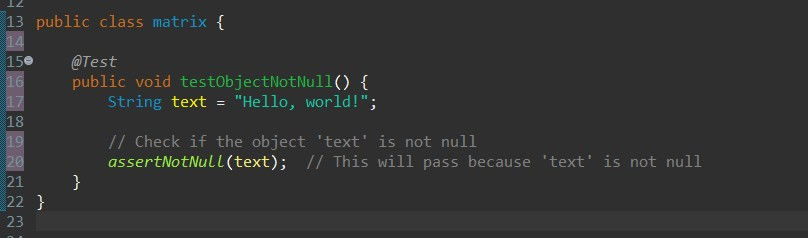
assertNull: Ensures that the object being tested is null. assertNull(object);

Each of these assertions helps confirm different aspects of an application’s behavior, such as conditions, equality, and object state.
Errors and Exceptions that might occur while using Assertion
When using assertions in Java, there are several common errors and exceptions that might occur. These typically happen due to incorrect assertion conditions, logical mistakes, or issues with the test framework setup. Here's a breakdown of the most common errors and exceptions you might encounter when working with assertions:
1. AssertionError
Cause: This is the most common error, and it occurs when the condition in an assertion is not met. For example, if you use assertEquals to check if two values are equal, but they are not, it throws an AssertionError.

Message: expected:<5> but was:<3>
2. NullPointerException
Cause: If you try to assert an object that is null when it shouldn’t be, or access a method or property of a null object in an assertion, it will throw a NullPointerException.

Message: java.lang.NullPointerException
3. IllegalArgumentException
Cause: Some assertion methods (like assertEquals) might throw an IllegalArgumentException if the arguments provided are incompatible, such as when comparing objects of different types.

Message: java.lang.IllegalArgumentException: argument type mismatch
4. AssertionError in Multi-threaded Environments
Cause: In multi-threaded tests, assertions may fail unexpectedly if threads are not properly synchronized, or if the test framework is not set up to handle concurrent execution correctly.

Message:
expected:<5> but was:<3>
5. Test Framework-Specific Exceptions
Cause: Frameworks like JUnit or TestNG may throw specific exceptions if there’s an issue with test annotations or setup.
Example (JUnit):
If the @Test annotation is missing, JUnit might not recognize the method as a test case.
If a test method is set up incorrectly (like an incorrect return type), the framework could throw an exception.
Message:
org.junit.runners.model.TestTimedOutException: test timed out after 100 milliseconds
6. TimeoutException
Cause: When an assertion is used with a timeout or depends on a condition being met within a specified time, a TimeoutException may occur.

Message:
org.openqa.selenium.TimeoutException: Timed out after 5 seconds waiting for visibility of element
7. AssertionError with Logical Errors in Test Conditions
Cause: If the assertion logic is incorrectly written, it can cause test failures. This could be a logical mistake in the way the assertion is structured.

Message:
expected: <true> but was: <false>
Best Practices for Using Assertions
Here are a few best practices to keep in mind when working with assertions:
Use Assertions to Test One Thing at a Time: Assertions should be used to check a single condition. Combining multiple assertions in one statement can make it harder to pinpoint the issue when a test fails. Each assertion should validate one behavior or state.
Be Clear and Descriptive in Messages: When an assertion fails, the error message should be descriptive enough to quickly understand what went wrong. This makes debugging easier and faster.
Don’t Overuse Assertions: While assertions are crucial, it’s important not to overuse them. Excessive assertions can make the tests unnecessarily complex and harder to maintain. Focus on critical functionality and edge cases.
Use Assertions to Catch Edge Cases: Assertions are great for validating edge cases, such as null values or empty inputs. Testing boundaries is just as important as testing the “happy path.”
Keep Your Assertions Meaningful: Assertions should test critical conditions in the application. For example, check if the result of a complex calculation matches the expected value, rather than testing trivial details like UI alignment.
Common Pitfalls to Avoid
While assertions are a vital part of your testing suite, there are some common mistakes to watch out for:
Redundant Assertions: Sometimes, testers overuse assertions for conditions that are already implicitly checked by the system. For instance, asserting that a method’s return value is non-null when the method is supposed to never return null adds unnecessary complexity.
Using Assertions for Side Effects: Assertions should not be used to check for side effects, such as verifying changes in the system’s state. Instead, side effects should be tested separately with appropriate methods or tools.
Not Testing Negative Cases: Many times, testers focus only on positive test cases (e.g., does the system behave correctly when everything is fine?). Don’t forget to test negative cases like incorrect inputs, unexpected behaviors, or error handling.
Lack of Assertions in Critical Test Scenarios: A common pitfall is not asserting critical behaviors, like checking if a user is successfully logged in or if a database update occurs. Without proper assertions, even successful test runs could miss important issues.
Conclusion
Mastering assertions is key to creating reliable and maintainable test cases. By sticking to best practices—like testing one condition at a time and keeping your assertions clear and meaningful—you can make your tests more effective. Avoid common mistakes such as using redundant assertions or making your tests overly complex. When used properly, assertions help create stronger applications and ensure fewer bugs go unnoticed.