Generative AI Explained: A Beginner's Guide with Real World Examples

Introduction
Have you ever asked ChatGPT to write an email, used Google Gemini to summarize a document, or seen AI generate stunning artwork from a simple sentence? If so, you've already experienced the power of Generative AI. Once considered futuristic, Generative AI has quickly become part of our everyday lives, helping people learn, create, solve problems, and work more efficiently. In this blog, we'll explore what Generative AI is, how it works, where it's being used, and why it's transforming the way we interact with technology.
What is Artificial Intelligence?

Artificial Intelligence (AI) is a branch of computer science that enables machines to perform tasks that typically require human intelligence. These tasks include learning from data, recognizing patterns, understanding language, solving problems, and making decisions. AI powers many technologies we use every day, from virtual assistants and recommendation systems to self-driving cars and fraud detection. Generative AI is one specialized branch of Artificial Intelligence that focuses on creating entirely new content.
What is Generative AI?
Generative AI is a subset of artificial intelligence that creates new, original content—such as text, images, audio, and code—by learning patterns from massive datasets. Instead of just analyzing or classifying existing data, it acts like a creative partner, synthesizing novel outputs based on the prompts you give it.
How Does Generative AI Work?

Imagine reading millions of books, articles, conversations, and websites throughout your life. Over time, you naturally learn grammar, writing styles, facts, and patterns. Generative AI works in a similar way. During training, it learns from enormous amounts of data to recognize relationships between words, images, sounds, and code. When you enter a prompt, the model predicts the most appropriate response based on everything it has learned. Although the output may seem intelligent, Generative AI does not truly think or understand like humans. Instead, it generates responses by recognizing patterns and probabilities from its training data.
Popular Generative AI Tools
Today, hundreds of Generative AI tools are available, each designed for different purposes such as writing, coding, image generation, research, and productivity. Here are some of the most popular platforms.
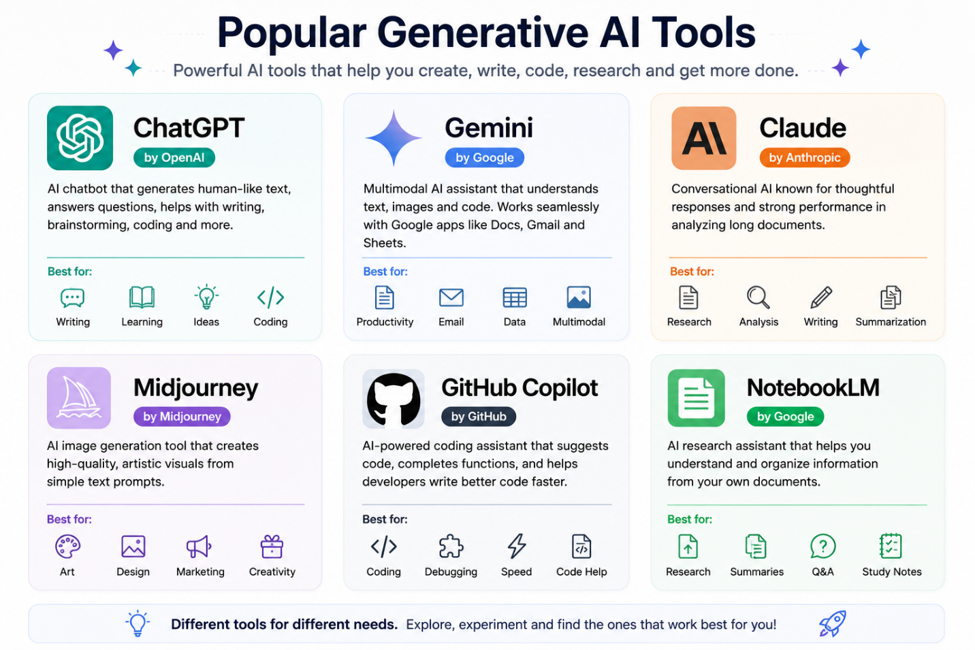
ChatGPT Developed by OpenAI, ChatGPT can generate human-like text, answer questions, summarize information, assist with writing, brainstorm ideas, and even help with coding. It is widely used by students, professionals, educators, and businesses.
Gemini Developed by Google, Gemini is a multimodal AI assistant that can understand and generate text, images, and code. It integrates seamlessly with Google Workspace applications such as Gmail, Docs, and Sheets, making it a valuable productivity tool.
Claude Created by Anthropic, Claude is known for its conversational abilities, thoughtful responses, and strong performance in analyzing long documents. It is often used for research, writing, summarization, and document analysis.
Midjourney Midjourney specializes in AI generated artwork. Users can create high quality images from simple text prompts, making it popular among designers, marketers, content creators, and artists.
GitHub Copilot GitHub Copilot is an AI powered coding assistant that helps developers write code faster by suggesting functions, completing code snippets, and providing programming recommendations across multiple languages.
NotebookLM
NotebookLM, developed by Google, is an AI powered research assistant that helps users understand and organize information from their own documents. It can summarize content, answer questions based on uploaded sources, and generate study notes, making it especially useful for students and researchers.
Real World Applications
Generative AI is transforming industries by improving efficiency, creativity, and decision making. Its ability to generate text, images, code, audio, and other content has made it a valuable tool across many fields.
Education Students and educators use Generative AI to create study materials, summarize complex topics, generate practice questions, and support personalized learning experiences.
Business Organizations use Generative AI to automate routine tasks, generate reports, analyze data, draft emails, and improve productivity, allowing employees to focus on higher value work.
Healthcare Healthcare professionals use Generative AI to assist with clinical documentation, summarize patient records, support medical research, and improve communication with patients. While AI can enhance efficiency, medical decisions should always involve qualified healthcare professionals.
Marketing Marketing teams use Generative AI to create blog posts, social media content, advertising copy, product descriptions, and email campaigns. It also helps generate creative ideas and personalize content for different audiences.
Software Development Developers use Generative AI to write code, explain programming concepts, identify bugs, generate documentation, and accelerate the software development process.
Customer Service Businesses use AI powered chatbots and virtual assistants to answer customer questions, provide product recommendations, resolve common issues, and offer support around the clock, improving both response time and customer satisfaction.
Benefits of Generative AI
Working on mundane and repetitive tasks can be draining and time-consuming for employees. Generative AI can speed up the process, offer valuable insights and improve employee productivity and efficiency. Here’s how Generative AI creates measurable advantages:
Saves Time AI can complete tasks such as drafting emails, summarizing documents, and generating reports within seconds.
Improves Productivity Professionals can automate repetitive work and focus on higher value tasks.
Enhances Creativity AI helps generate ideas, create designs, and overcome creative blocks.
Automates Repetitive Work: Routine tasks like data entry, document formatting, and content generation become faster.
Personalizes User Experiences AI recommends content and tailors responses based on user preferences.
Supports Better Decision Making AI analyzes large amounts of information to generate useful insights.
Challenges of Generative AI
Generative AI is a transformative technology, but it operates through probabilistic pattern-matching rather than true reasoning. This introduces major challenges: producing factually incorrect or fabricated information, perpetuating societal biases, compromising data privacy, infringing on intellectual property, and diminishing critical human skills through overreliance.
Hallucinations
Generative AI models often produce "hallucinations," which are plausible, highly authoritative, but entirely fabricated or incorrect statements, dates, and citations.
Bias
AI outputs frequently mirror or amplify historical prejudices, stereotypes, and inequalities.
Privacy
Feeding sensitive or proprietary information into public AI models poses a significant risk to personal privacy.
Copyright
AI-generated content has sparked complex legal and ethical debates regarding intellectual property and originality.
Overreliance
Users often develop a misplaced trust in AI outputs due to the tool's confident, fluent tone and human-like writing.
The Future of Generative AI
The future of Generative AI looks incredibly promising. As AI models become more accurate, affordable, and accessible, they will continue to transform education, healthcare, finance, marketing, and software development. We can expect AI assistants to become a standard part of our daily work, helping people complete tasks more efficiently while supporting creativity and innovation. However, responsible AI development, ethical guidelines, and human oversight will remain essential to ensure these technologies are used safely and fairly.
Key Takeaways
Generative AI creates new content such as text, images, code, and audio.•It learns patterns from massive datasets instead of simply storing information.• AI tools are improving productivity across education, healthcare, business, and software development.• While Generative AI offers many benefits, users should remain aware of challenges such as bias, privacy, and misinformation.• Human oversight remains essential for using AI responsibly.