CTE vs View vs Materialized View — A Deep, Practical Guide Using a Real Heart Disease Dataset

In SQL and Data Analytics projects, one question appears again and again
Should i use CTE , VIEWS or MATERIALIZED VIEW ????
At first glance, all three seem to do the same thing , they return query results that look like tables. But in real-world projects, choosing the wrong one can lead to:
Slow dashboards.
Repeated and messy SQL logic.
Confusion across teams.
Performance bottlenecks in production.
This blog is written as a practical learning guide, not a textbook definition. By the end, you will clearly understand:
What a CTE, View, and Materialized View really are?
How they differ in behavior, performance, and purpose?
How to use each one with a real Heart Disease dataset?
Why a data analyst or engineer would intentionally choose one over the others?
Dataset Used: Heart Disease Dataset
Throughout this blog, we use a real healthcare analytics dataset related to heart disease. Assume the table name is heart_data with the following columns:
Age – Patient age.
Sex – Gender of the patient.
ChestPainType – Type of chest pain.
RestingBP – Resting blood pressure.
Cholesterol – Serum cholesterol.
MaxHR – Maximum heart rate achieved.
ExerciseAngina – Exercise-induced angina (Yes/No).
ST_Slope – Slope of peak exercise ST segment.
HeartDisease – Target variable (0 = No, 1 = Yes).
This dataset is commonly used to analyze cardiovascular risk patterns and is realistic enough to represent real healthcare analytics workflows.
Understanding the Core Problem
Before jumping into definitions, it’s important to understand the core problem these SQL features solve.
In analytics work, we often:
Write complex queries with multiple steps.
Reuse the same logic across dashboards and reports.
Run heavy aggregations repeatedly on large datasets.
CTEs, Views, and Materialized Views exist to solve different versions of these problems.
CTE(COMMON TABLE EXPRESSION)
What is a CTE (Common Table Expression)?
A CTE is a temporary named result set that exists only during the execution of a single query.
Think of it as:
“Let me break my query into logical steps so it’s easier to read and reason about.”
Once the query finishes executing, the CTE disappears.
Why CTEs Matter in Real Projects
Without CTEs, analysts often write deeply nested subqueries that are:
Hard to read.
Difficult to debug.
Nearly impossible to explain in interviews.
CTEs solve this by making SQL modular and readable.
CTE Example: Exploratory Analysis
Business Question:
Do patients with heart disease show higher average cholesterol and resting blood pressure?
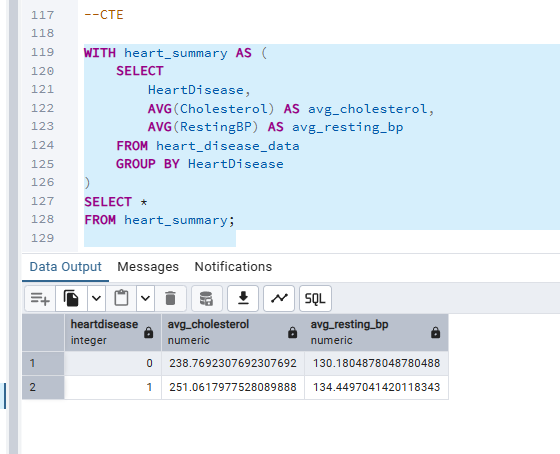
Why a CTE is the Best Choice Here:
This is a one-time analysis.
The result is not reused elsewhere.
The logic is clearer than a nested query.
Insight: CTEs are best when clarity matters more than reuse or performance optimization.
VIEW
What is a View?
A View is a stored SQL query that behaves like a virtual table.
Important distinction:
A View stores the query logic, not the data.
Every time you query a View, the database re-executes the underlying SQL.
Views help teams work with consistent definitions of data.
Why Views Matter in Team Environments
In real analytics teams:
Multiple analysts query the same dataset.
Business logic must stay consistent.
Rewriting the same SELECT logic leads to errors.
Views solve this by acting as a shared analytical layer.
View Example: Reusable Patient Feature Layer
Analysts frequently need a standardized patient-level dataset for heart disease analysis.

when we query the view the SQL logic written in the create statement is executed and we get the latest updated results:
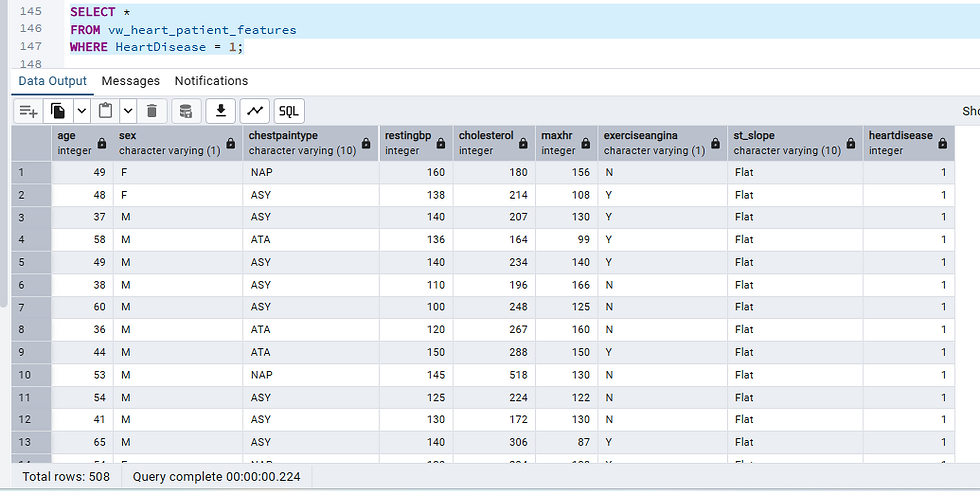
Why a View is the Best Choice Here
Logic is reused across multiple analyses
Prevents column mismatches or missing fields
Acts as a semantic layer for analysts
Insight: Views are best for reuse, consistency, and abstraction ,not performance. They are not considered best for peformance because the SQL logic runs everytime we run the query not optimizing the time.
MATERIALIZED VIEW:
What is a Materialized View?
A Materialized View stores the actual result of a query on disk.
Think of it as:
“Run this heavy query once, save the result, and reuse it instantly.”
This dramatically improves performance but introduces data freshness trade-offs.
Why Materialized Views Exist
In dashboards and BI tools:
The same aggregations run repeatedly
Queries may scan millions of rows
Performance becomes critical
Materialized Views solve this by precomputing results.
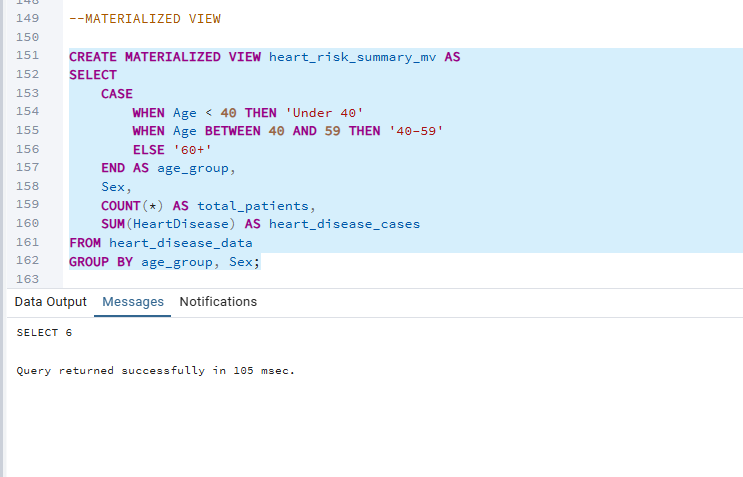
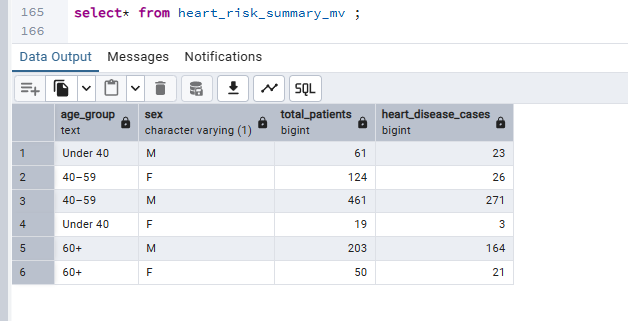
Materialized View Example: Dashboard Optimization
A dashboard shows heart disease risk metrics by age group and sex.
Important Note:
Materialized views need to be refreshed to get the updated data .
ex:
Refreshing the data:
REFRESH MATERIALIZED VIEW heart_risk_summary_mv;
Why a Materialized View is the Best Choice Here
Aggregation is computationally expensive
Metrics are reused across dashboards
Data does not need real-time updates
Insight: Materialized Views are best when performance matters more than latest data. like if we refresh the data once in a day its enough and we can use it through out the day in those scenarios MATERIALIZED VIEW is best option.
Comparing All Three Side by Side:
FEATURE | CTE | VIEW | MATERIALIZED VIEW |
STORES DATA | NO | NO | YES |
LIFETIME | ONE QUERY | PERMANENT | PERMANENT |
REUSABLE | NO | YES | YES |
PERFORMANCE | MEDIUM | MEDIUM | FAST |
STORAGE USED | NO | NO | YES |
BEST USE CASE | READABILITY | REUSABILITY | PERFORMANCE |
How Data Professionals Decide in Real Projects
Ask these questions in order:
Is this logic only needed once?→ Use a CTE
Will multiple people reuse this logic?→ Use a View
Is this powering dashboards or frequent reports?→ Use a Materialized View
This decision-making framework is what interviewers and senior analysts look for.
Real-World Analytics Takeaway
In production analytics systems:
CTEs help analysts think clearly
Views help teams collaborate
Materialized Views help systems scale
Using the correct structure improves:
Query performance
Code readability
Long-term maintainability
Key Takeaways:
CTEs, Views, and Materialized Views are not interchangeable tools.
CTE → clarity and logic
View → reuse and consistency
Materialized View → speed and scalability
Knowing why to use each one transforms your SQL from basic querying into professional-grade analytics engineering.
This understanding is critical for real-world projects, interviews,
Hope this blog helped you understand about CTES , VIEWS AND MATERIALIZED VIEW better and their applicability in real world scenarios.