Constructors in Java
In Java, a constructor is a special method that is called when an object of a class is created. It is used to initialize the newly created object and set its initial state. A constructor has the same name as the class and does not have a return type, not even void.
Key Points :
Name: The constructor's name must be the same as the class name.
No return type: Constructors do not have a return type, not even void.
Automatic call: A constructor is automatically called when an object is instantiated using the new keyword.
Types of Constructors:
Default Constructor: A constructor that takes no arguments and is provided by Java if you don't define any constructor. It initializes the object with default values.

Parameterized Constructor: A constructor that allows you to pass parameters to initialize an object with specific values when it is created.
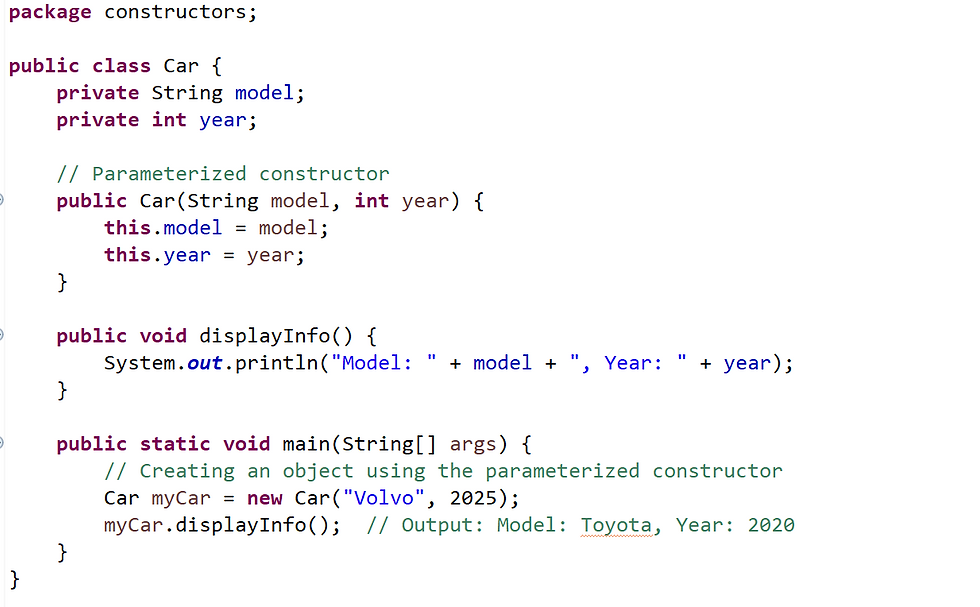
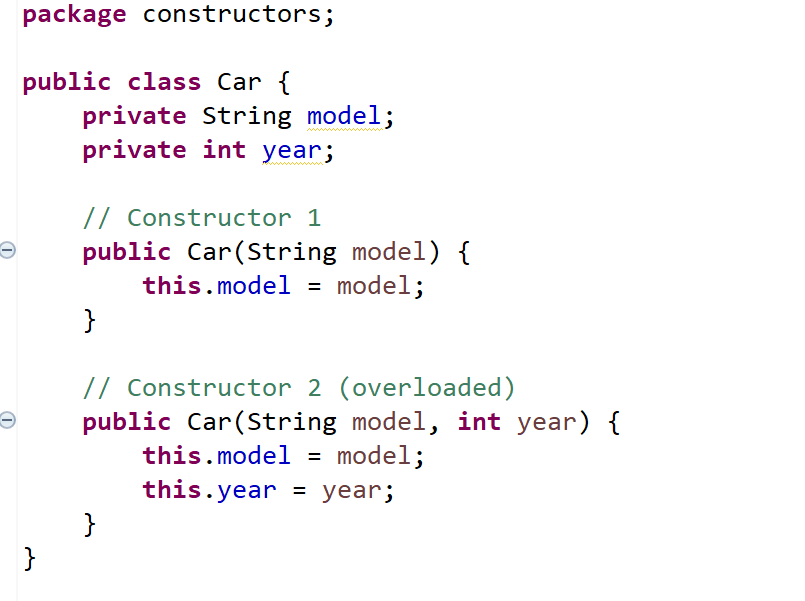
Constructor Overloading:
In Java, you can have more than one constructor in a class with different parameter lists. This is called constructor overloading. Each constructor must have a different parameter signature.
This Keyword in Constructors
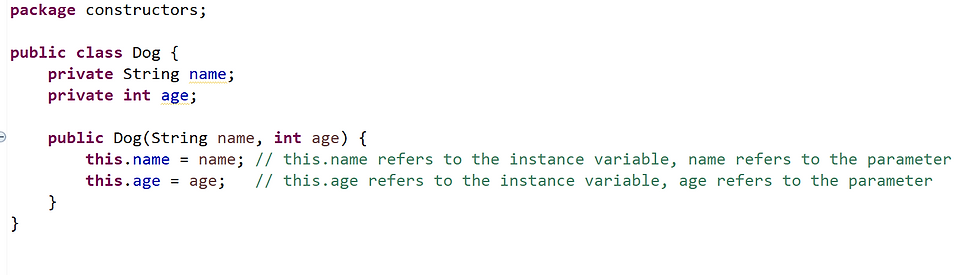
In Java, the this keyword is a reference to the current object. Within a constructor, this can be used in two primary ways: to differentiate between instance variables and parameters with the same name, and to call another constructor within the same class.
Constructor Chaining:
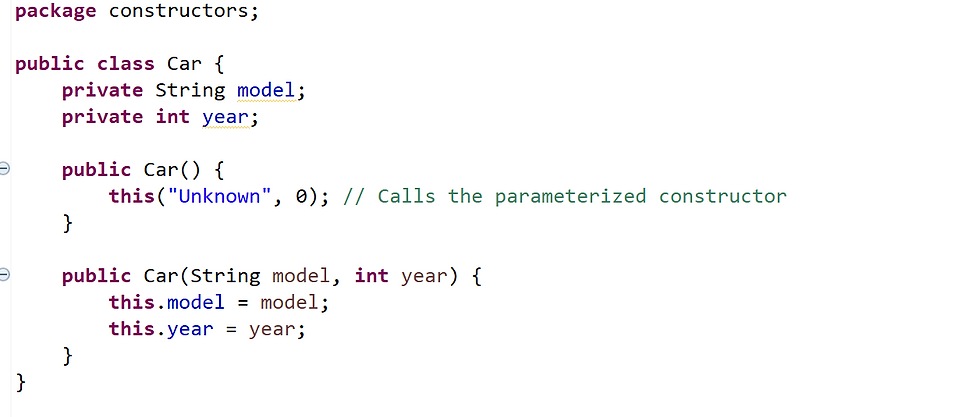
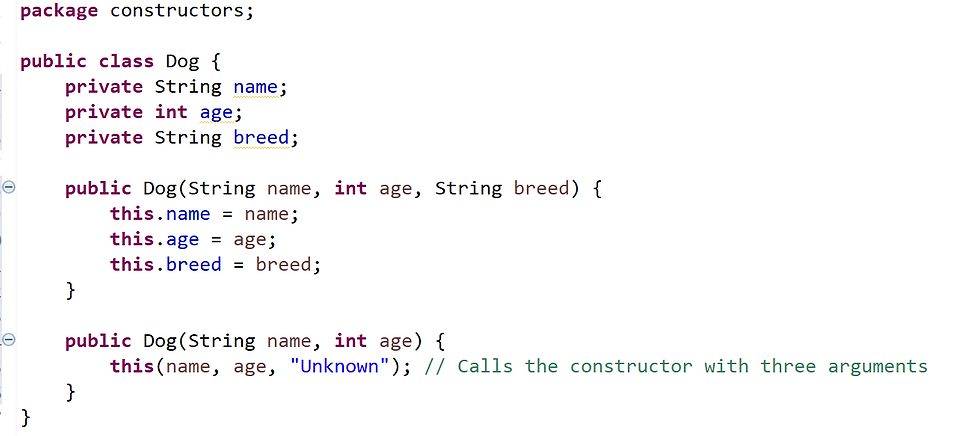
Constructor chaining is the process of calling one constructor from another constructor in the same class or in the parent class.
Within the same class: You can call one constructor from another constructor using the this() keyword.
From the parent class: You can call the parent class's constructor using the super() keyword.
Differentiating Instance Variables and Parameters
When a constructor parameter has the same name as an instance variable, this is used to specify that you are referring to the instance variable.
Calling Another Constructor
this() can also be used to call another constructor within the same class. This is useful for constructor chaining, where one constructor can invoke another to reuse initialization logic. It must be the first statement in the constructor
The difference between constructor and method in Java
In Java, a constructor initializes a new object, while a method performs a specific task or operation on an object, and they differ in their purpose, naming conventions, and return types.
Constructors:
Purpose: Used to create and initialize objects of a class.
Name: Must be the same as the class name.
Return Type: Constructors do not have a return type, not even void.
Invocation: Automatically called when an object is created using the new keyword.
Overloading: Can be overloaded, meaning you can have multiple constructors with different parameters.
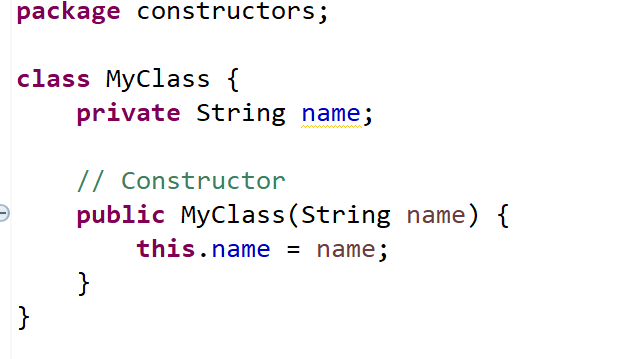
Example:
Methods:
Purpose: Used to perform specific actions or operations on an object.
Name: Can have any valid Java identifier as a name, not necessarily the same as the class name.
Return Type: Methods can have any return type, including void.
Invocation: Called explicitly by using the object name followed by a dot and the method name.
Overloading: Can be overloaded, meaning you can have multiple methods with the same name but different parameters.
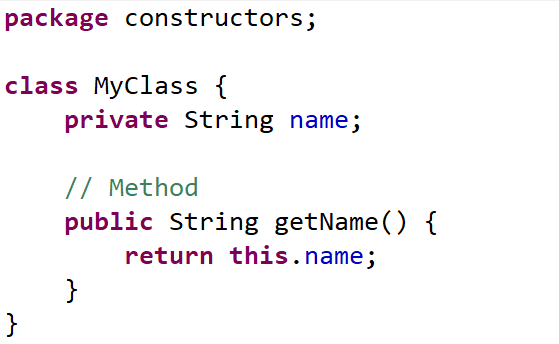
Example: