Combining Data Analysis with Healthcare: A Boon to Healthcare

What are the benefits when a team of highly skilled health professionals and Data analysts team up together to improvise healthcare? In this blog, we are going to understand the perspective of combining Data Analysis to improvise Healthcare.
"Healthcare through data analysis" refers to the practice of using data analytics techniques to examine large volumes of clinical data, like patient records to gain insights that can improve patient care, optimize operations, and make informed healthcare decisions.
When a data set is analyzed, the analysis will help the healthcare professionals in several ways like:
Identifying high-risk patients.
Identifying patterns in the dataset to be prepared with future course of treatment
May help in optimizing resource allocation plans to tackle the problem in a better way.
Tailoring treatment plans based on individual patient data.
Predicting disease outbreaks.
Lets understand this concept with the analysis of sepsis dataset using Tableau.
What is sepsis?
SEPSIS is a life threatening condition that arises when the body's response to an infection will damage it's own organs. The infection will weaken the immune system causing one/more body organs to dysfunction and if severe it could ultimately result to death. Not all the infections can cause SEPSIS but any infection has potential to lead to SEPSIS.
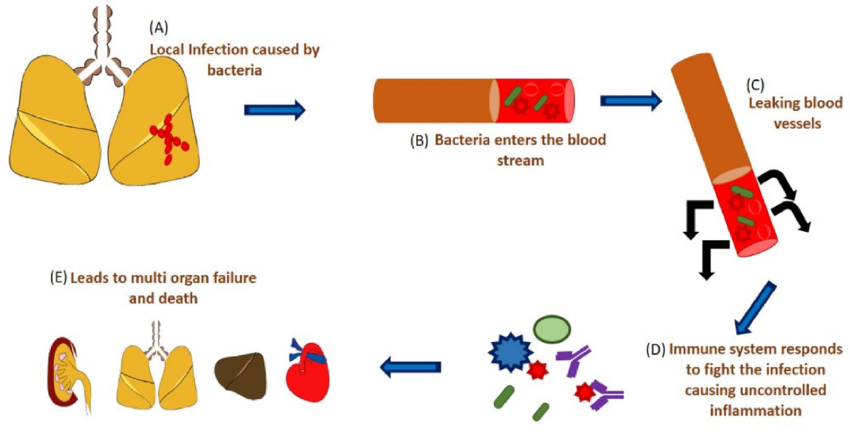
In this sepsis dataset, there are various vital signs measured for each patient on periodic basis.
For the sake of analysis, let us consider 2 Biomarkers:
Troponin
Heart Rate
Why Troponin and Heart Rate?
Research says that abnormal Troponin levels and High Heart rate is considered as an emergency.
Troponin is a protein found in heart muscle cells that leaks into the bloodstream when the heart is damaged.
Purpose of measuring troponin levels in blood:
The most common use of troponin tests is to confirm or rule out a heart attack. However, any kind of damage to heart muscle can potentially cause the release of this chemical into your bloodstream. Other conditions that can cause your troponin levels to increase include:
Pulmonary embolism (a blood clot in your lungs).
Heart surgery.
Heart valve diseases.
Exercising too much or too strenuously.
Extreme emotional strain, such as grief or stress.
Troponin test result ranges:
In healthy adults, the reference range (expected level) of troponin is very low or undetectable. When troponin levels are higher than the reference range that means damaged heart muscle cells are leaking troponin into your blood.
The reference ranges for the troponin test, according to the American Board of Internal Medicine, are measured in nanograms per milliliter (ng/mL). They are:
Troponin I: 0 - 0.04 ng/mL.
Troponin T: 0 - 0.01 ng/mL.
The sepsis dataset lists the Troponin I levels of patients. With lowest being 0.01 and highest being 381.6.For our analysis we will be considering Troponin I levels as 'Normal', 'Elevated Troponin' and 'Very High Troponin'.

Observations from the chart(Fig 2):
Troponin levels of male patients in the age group 50-80 seems to be high when compared to female patients.
Higher Number of male patients with "Very High Troponin" levels than female patients.
Both "Elevated " and "Very High Troponin" levels in male patients for the age group of 60.
With the analysis of high troponin, the next level of analysis is using the vital sign- HR (Heart Rate) from the dataset because a high troponin level, measured through a blood test, indicates potential heart damage and is often associated with an elevated heart rate (tachycardia) as a vital sign, meaning a rapid heartbeat; both are important factors considered when evaluating a suspected heart attack or myocardial infarction (MI).
Why an analysis of troponin and heart rate together?
Troponin as a marker:
Troponin is a protein released into the bloodstream when heart muscle is damaged, so a high troponin level signifies cardiac injury.
Heart rate and cardiac demand:
A rapid heart rate can increase the oxygen demand of the heart, potentially leading to further damage and a higher troponin level.
How they are used together:
Diagnosing a heart attack:
When a patient presents with chest pain and other concerning symptoms, healthcare providers will often check both troponin levels and heart rate to assess the likelihood of a heart attack.
Monitoring severity:
Serial troponin measurements along with heart rate monitoring can help track the extent of heart damage and guide treatment decisions.
In this dataset, the analysis of 2 Biomarkers -Troponin levels and HR is to understand the possibility of sepsis severity.
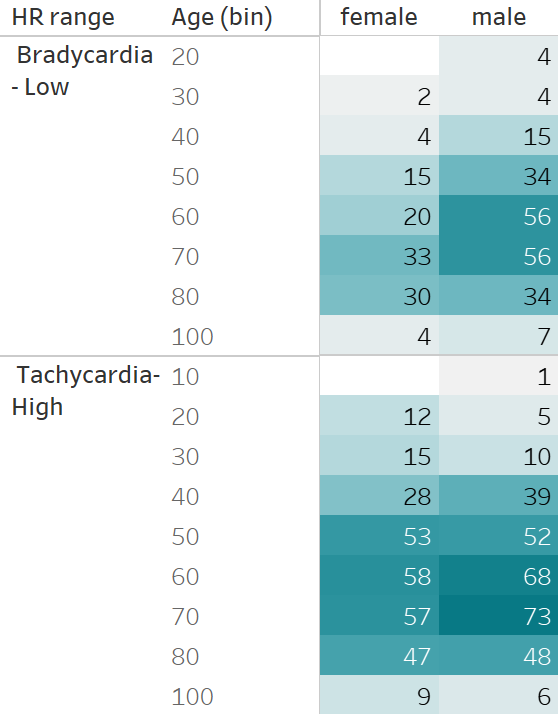
From the above analysis, we get the count of patients with high Heart rate and Abnormal troponin levels in both male and female patients. Upon drilling down this set of patients with high Heart Rate and Abnormal Troponin scores, we can list out the patients as "High risk" (shown in Fig 4) with the condition of
Sepsis
High Heart rate
Abnormal Troponin levels
As such abnormal troponin levels with high Heart rate itself is considered as a possible heart failure. If patients with such Heart rate and Troponin levels are found to be down with sepsis too. Then considering such patients as "High risk" patients helps in improving the monitoring and providing the healthcare measures.
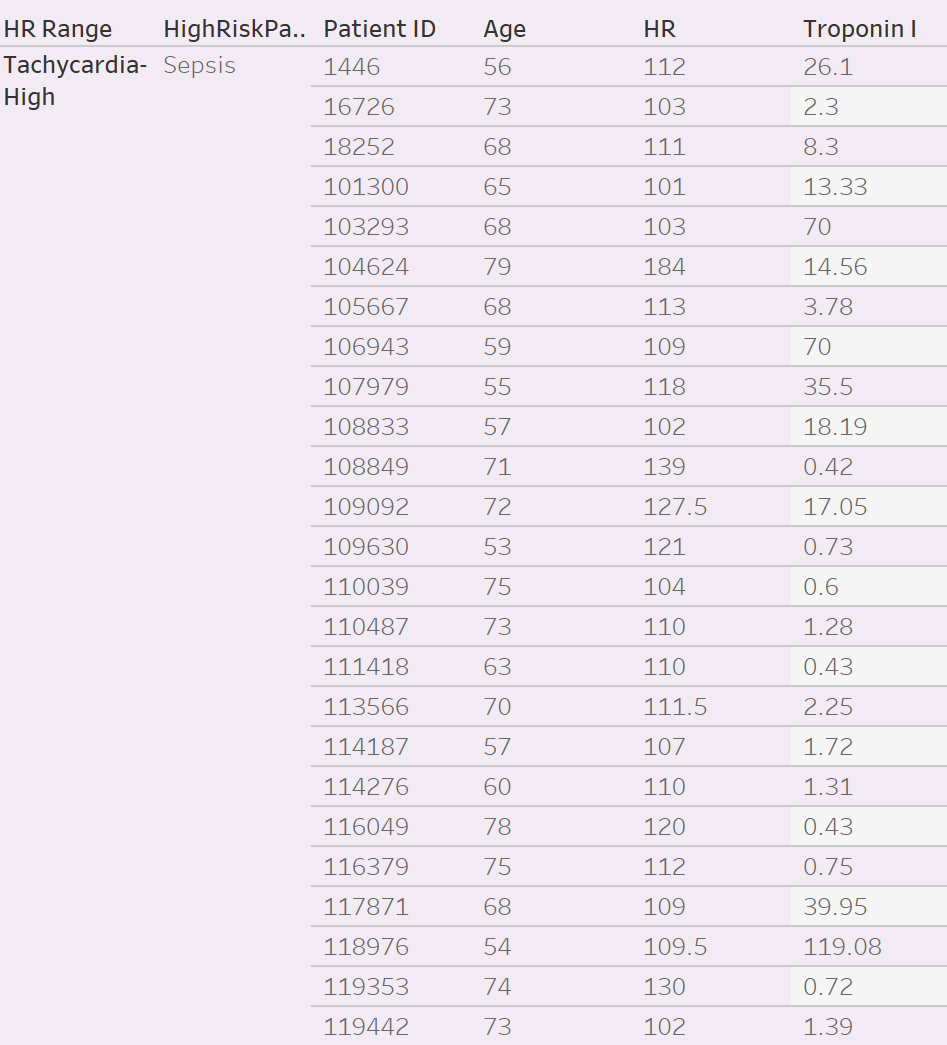
This is one instance of identifying high risk patients which helps in decision making and enhancing the health care facilities to the patients.
References: