A Beginner’s Guide to Sepsis Using SIRS and SOFA Scores

Introduction
Sepsis is a life-threatening medical emergency caused by the body’s overwhelming response to infection, leading to inflammation and organ dysfunction. Sepsis progresses rapidly and can lead to tissue damage, multiple organ failure and even associated with higher risk of mortality. As sepsis care evolved, clinical tools including SIRS and the SOFA score have become essential for identifying, tracking, and management of sepsis.

Image Credit: doctorswithoutwaitingrooms
Stages of Sepsis
Sepsis advances through multiple stages, becoming more severe when not treated early. Early detection at each stage is critical to prevent organ failure and death.
Sepsis: An infection gets into bloodstream and causes inflammation in the body. Clinical signs include fever or hypothermia, rapid heart rate, rapid breathing and abnormal mental status.
Severe Sepsis: This stage associated with significant organ dysfunction. Symptoms may include low urine output, difficulty breathing, abnormal lab values and cognitive changes.
Septic Shock: Septic Shock is the most severe stage of sepsis which causes a significant drop in blood pressure and may lead to serious complications like organ dysfunction, respiratory or heart failure, stroke. Patients often require vasopressors and intensive care, and mortality risk is extremely high.
SIRS: Early Screening for Systemic Inflammation
SIRS (Systemic Inflammatory Response Syndrome) is body’s inflammation response due to infection and it’s a critical screening tool to identify patient risk at the earliest. Several conditions can cause SIRS like abnormal temperature, elevated heart rate, increased respiratory rate and abnormal white blood cell count. A patient meets SIRS criteria when two or more abnormal values are present.

Image Credit: baciamistupido
Implementing SIRS Analysis in Tableau
Implementing SIRS criteria in Tableau, each criteria is defined as calculated field using simple logic.
For example, Temperature can be measured as follows:
Temperature
IF [Temp] > 38.5 OR [TEMP] < 35
THEN ''Abnormal"
ELSE "Normal"
END
Binary SIRS Flag (Optional):
Temperature_Flag
IF [Temp] > 38.5 OR [TEMP] < 35 THEN 1 ELSE 0 END
Similarly, Calculated fields can be created for heart rate, respiratory rate and white blood cell count. These individual calculated fields are combined to identify patients who meet more than two SIRS criteria.
SIRS_SCORE
IF { FIXED [Patient ID] : MAX (
IF [Temp] > 38.5 OR [TEMP] < 35 THEN 1 ELSE 0 END +
IF [HR] > 90 THEN 1 ELSE 0 END +
IF [Resp] > 20 OR [PaCO2] < 32 THEN 1 ELSE 0 END +
IF [WBC] > 12 OR [WBC] < 4 THEN 1 ELSE 0 END ) } >= THEN [Patient ID]
END
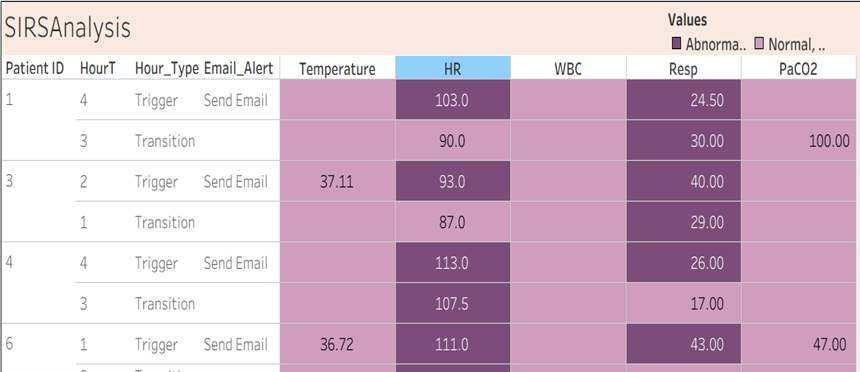
The following table indicates how SIRS Analysis is evaluated across patients using calculated fields and visualized in tableau. Each column in heatmap represents laboratory values, with darker color indicating abnormal SIRS criteria, and rows with two or more abnormal values classified as SIRS positive.
Visualization Link: SIRS Analysis
Trigger Hour represents first detection of sepsis risk and Transition hour represents when the sepsis worsens. An email alert is sent to clinician at the Trigger hour when SIRS is first identified, while Transition hours reflect continued monitoring of the patient’s condition.
Overall, using calculated fields to implement SIRS analysis transforms raw clinical data into structured meaningful screening tool. This methodology demonstrates how clinical definitions can be translated in a visualization platform to support early detection and improve awareness in sepsis management.
SOFA Score: Assessing Organ Dysfunction and Severity
While SIRS identifies inflammation, it does not indicate how severely the body is affected. To address this, the SOFA (Sequential Organ Failure Assessment) score measures how severely sepsis affects patient’s organ. SOFA evaluates six major organ systems – lungs, blood, liver, heart, brain and kidneys. Each system is scored from 0 to 4. An increase in SOFA score of two or more points strongly associated with sepsis and higher mortality.

Image credit: guideofgreece
Implementing SOFA Score Analysis in Tableau
In Tableau, SOFA implementation begins by calculating scores for each organ system using available laboratory and clinical measure. For example, the respiratory SOFA component evaluates how well the lungs are functioning. Higher scores indicate increasing respiratory failure, which commonly appears early in severe sepsis.
Respiration
IF AVG ( [ [ PaO2 ] / [ FiO2 ] ] ) >= 400 THEN 0
ELSEIF AVG ( [ [ PaO2 ] / [ FiO2 ] ] ) < 400 AND AVG ( [ [ PaO2 ] / [ FiO2 ] ] ) >= 300 THEN 1
ELSEIF AVG ( [ [ PaO2 ] / [ FiO2 ] ] ) < 300 AND AVG ( [ [ PaO2 ] / [ FiO2 ] ] ) >= 200 THEN 2 ELSEIF AVG ( [ [ PaO2 ] / [ FiO2 ] ] ) < 200 AND AVG ( [ [ PaO2 ] / [ FiO2 ] ] ) >= 100 THEN 3 ELSEIF AVG ( [ [ PaO2 ] / [ FiO2 ] ] ) < 100 THEN 4
END
Next, calculating the total SOFA score of two or more indicates cumulative organ dysfunction. As the score increases, the risk of poor outcomes and mortality increases, making it a key severity indicator in sepsis.
Total_SOFA_Score
INT ( [ Respiration] ) +
INT ( [ Coagulation] ) +
INT ( [ Liver] ) +
INT ( [ Renal] )
This severity category calculated field enables visual grouping of patients by severity.
SOFA_Score
IF [ Total_SOFA_Score] <= 2 THEN "No Organ Dysfunction"
ELSEIF [ Total_SOFA_Score] >2 AND[Total_SOFA_Score] <= 5 THEN "Mild Organ Dysfunction"
ELSEIF [ Total_SOFA_Score] >5 AND [ Total_SOFA_Score] <= 9 THEN "Moderate Dysfunction"
ELSEIF [ Total_SOFA_Score] >9 AND [ Total_SOFA_Score] <= 12 THEN "Severe Sepsis"
ELSEIF [ Total_SOFA_Score] >= 13 THEN "Multiple Organ Failure"
END
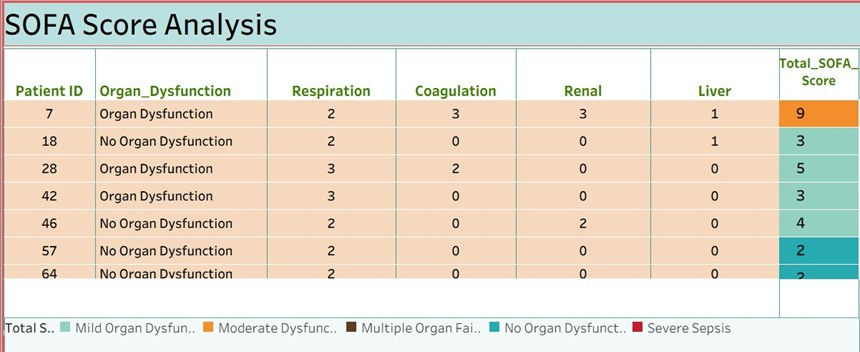
In this table, each row represents an individual patient, and the column displays SOFA component score for Respiration, Coagulation, Renal and Liver functions. The total SOFA score on rightmost gives an overall picture of patient’s organ dysfunction level. The color shading represents the severity level. By comparing these columns, we can see which organ are most affected and how they contribute to the total SOFA score.
Visualization Link: SOFA Analysis
Overall, the SOFA score Analysis visualization converted complex clinical data into a clear severe overview. It helps clinicians assess organ dysfunction at both individual and population levels. It supports sepsis monitoring, treatment guidance and decision making in critical care.
How SIRS and SOFA Work together in Real-world Projects
In real-world sepsis analysis, SIRS and SOFA are commonly used together, with the SOFA score complementing SIRS rather than one replacing it. In practice:
SIRS helps clinicians recognize early systemic stress
SOFA helps assess organ failure and disease severity
Using both tools together makes it easier to move from early screening to ongoing monitoring. This combined approach allows clinicians to detect sepsis earlier, monitor sepsis progression more accurately, and adjust treatment strategies as patient status changes.
Why Early Recognition Saves Lives
Sepsis is time-sensitive. Each hour of delay in treatment increases the risk of organ failure and death. Early recognition enables faster antibiotics, timely fluid support. It also allows close organ monitoring and appropriate escalation of care, significantly improving patient outcomes.
Conclusion
Sepsis remains a major global health challenge due to its rapid progression and high mortality. SIRS plays a crucial role in early inflammatory screening but lacks the accuracy needed for severity assessment. The SOFA score addresses this gap by evaluating organ dysfunction and predicting outcomes. When these tools are implemented through structured methodologies and visualized using Tableau, they transform complex clinical data into practical, real-world decision-support systems. This integrated approach demonstrates how sepsis analytics moves from theory to effective implementation in healthcare and training environments.
References
National Institute of General Medical Sciences (NIGMS), Sepsis and Systemic Inflammatory Response - https://www.nigms.nih.gov/
Cleveland Clinic, Sepsis and Critical Care Resources - https://my.clevelandclinic.org/
Virginia Health Technology Center, Systemic Inflammatory Response Syndrome (SIRS) - https://www.vhtc.org/2025/06/systemic-inflammatory-response-syndrome.html
Sepsis dataset and code used for analysis — Kaggle: Sepsis Classificationhttps://www.kaggle.com/code/namratakapoor1/sepsis-classification/output